
(And why a pediatrician said "try saffron first.")
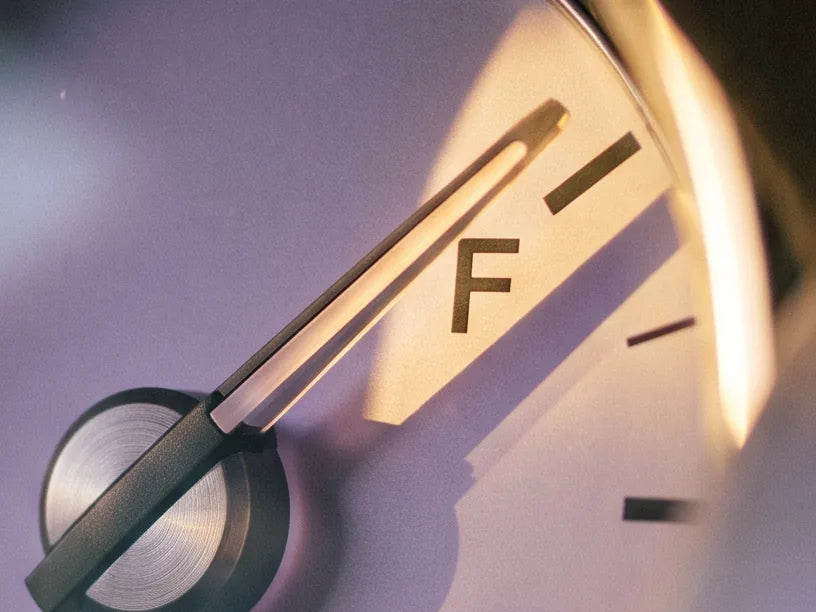

This is a gas gauge at 7 in the morning.
Full. The whole day ahead of it.
This is the same gauge at 3 in the afternoon.
Now picture that gauge inside your kid.
Because for a lot of kids, this is exactly what a school day does.
They leave the house full.
They come home empty.
And an empty tank doesn't look like "tired."
It looks like the door slamming.
It looks like tears over the wrong cup.
It looks like a kid who was fine all day and can't be fine for you.
Most of us were told the after-school meltdown is a behavior problem.
A discipline problem. A screen problem. A "he just needs to try harder" problem.
And most kids' vitamins are built for a different job entirely: a picky eater's multi, not a 3 p.m. crash.
Here's why it's mostly a tank problem.
A growing brain runs its day on three chemicals.
Three tanks, one school day. A picture of the idea, not data.
Some kids simply start the day with a smaller tank of them.
And the school day drains it.
Every "sit still." Every noise. Every transition. Every "eyes on me."
By pickup, there's nothing left.
That's not a bad kid.
That's a small tank on an empty road.
Stick with me for about four minutes...
I'm going to show you the study where a kitchen spice went head-to-head with a common focus medicine in 54 kids for 6 weeks. And held its own.
I'm going to show you why the things you've already tried didn't touch the 3 p.m. crash.
And I'm going to show you the 12-second, sugar-free habit a lot of moms are now trying before medication. Not instead of a doctor. Before.
If you've got a kid who's great for their teacher and a wreck for you, this is for you.
You've already tried things.
Magnesium. Fish oil. The patches. The gummies that are basically candy.
Cutting sugar. Cutting screens. The reward chart that lasted nine days.
Some of it helped a little. Most of it sits in the cabinet.
So you don't need another bottle.
You need to know why the other bottles didn't work.
And it's not because you did it wrong.
Most of them fill one thing.
A small tank is short on several.
Magnesium alone. Fish oil alone. A "multi" spread so thin nothing in it does much. Each one fills a corner of the tank and leaves the rest empty.
Before we go on: I'm not a doctor, and this page isn't medical advice.
We're the team behind Bloomwise, a kids' meltable built by parents who were tired of the same 3 p.m. as you.
Everything below either comes from a published study you can click, or from a parent who wrote to us and let us share it. We'll tell you what the studies tested and what they didn't. That's the deal on this page.
Her words, from a post she shared in August:
She's not anti-medicine. She's careful.
She wanted to look at lifestyle, nutrition, sleep, movement, foundations first.
And she was scared of the two things every mom is scared of.
Then her pediatrician said something she didn't expect.
Try saffron. Before Adderall.
Her pediatrician's explanation is the best one we've heard:
So Amanda bought a bottle. And agreed with her husband to see the whole thing through before deciding.
Here's her week one, exactly as she wrote it:
And the part we respect most:
That's the whole spirit of this page.
Not magic. Attention.
Amanda's words are quoted from her own post, shared with permission. Every kid is different.
The tank picture is simple. The real thing is only a little more complicated.
Those three chemicals aren't made from nothing.
The brain builds them from raw materials.
Amino acids. Zinc. Magnesium. Vitamin D. B vitamins. And a working gut, where most of the serotonin actually gets made.
If the raw materials run short, the tank starts the day low.
And when a low tank hits a loud day, the brakes go first.
Not the love. Not the smarts. The brakes.
That's why your kid can hold it together for a teacher for six hours.
He's spending everything he has to do it.
And then he walks in your door, the one safe place, and the tank reads empty.

He saves the crash for you.
Because you're the safe one.
A picture of the idea, not data.
Gummy vitamins are the biggest seller in the kids' aisle. Most of them are sugar first, vitamins second. A spike at breakfast, a crash by second period, and nothing left for 3 p.m.
So how do you keep the tank from hitting empty? Here's the honest list.
But a lot of parents want to try the foundations first. Nutrition. Sleep. Movement.
That's the road Amanda's pediatrician pointed her down.
And that's where a spice from a flower comes in.
Pick up any kids' vitamin and look for a study on focus or calm. You won't find one. That's the part Amanda's pediatrician knew.
Each ingredient with a story and a real number. Nothing rounded up.

In 2019, researchers took 54 children with ADHD, ages 6 to 17.
Half got saffron. Half got methylphenidate, the medicine most parents know as Ritalin.
Six weeks. Doctors and parents rated the kids on the same scales.
Both groups improved about the same.
Side effects were similar in both groups.
That's it. That's the study. A spice held its own against a stimulant for six weeks in 54 kids.
It was one study, and a short one. We'll say that again lower down.
But if you've been told "natural" means "does nothing," this is the study to click.
Improved about the same
54 children, six weeks. Bars show the finding, not plotted data. J Child Adolesc Psychopharmacol, 2019
66 kids with ADHD. Eight weeks. Vitamin D plus magnesium, or a placebo.
Parents filled in behavior checklists.
The supplement group's checklists came back calmer. Fewer of the big blowups.
98 boys with ADHD wore sleep trackers for five nights.
The theanine group slept more of the night. And stayed asleep once they got there.
Not faster. More. A full tank starts with a full night.
Zinc sits right in the dopamine pathway, the "focus" chemical.
Studies keep finding that kids with focus challenges tend to run lower on it than their classmates.
Most serotonin is made in the gut, not the head.
A small pilot study looked at probiotics in kids with ADHD and saw enough to keep researchers interested. Small pilot. We'd rather say that than oversell it.
Not a horse pill. Not a gummy full of sugar. Not four bottles and a fight every morning.
So we made one.
Bloomwise Kids Meltable.
Fourteen ingredients in one berry meltable that dissolves on the tongue in about twelve seconds.
Saffron. Vitamin D. Magnesium. L-theanine. Zinc. B vitamins. Probiotics. And the rest of the shelf a growing brain runs low on.
Zero sugar. No stimulants. Nothing that sedates. Nothing that changes who your kid is.

Two with breakfast. Fills the tank.
Two after school. Tops it off before the 3 p.m. cliff.
No water. No chewing. No negotiation.
Twelve seconds and you're done.

"He came home from school today and said school work felt easier, not only that homework tonight was a night and day difference. Yes he complained but there was no meltdown/tantrum."
Samantha Turner, mom of a 6-year-old"There was a noticeable difference in 3 weeks. I didn't have to repeat myself constantly, he was more independent with his hygiene tasks, and didn't get angry so quickly as before. I was late in ordering... so he went without it for 3 days. All of the improvements disappeared."
Traci Marie Freeze Goltz, mom of a 9-year-old"My daughter which is in 5th grade teacher told her that she was much focus in yesterday class."
Conique Coko Taylor"We are on week 2 and noticed a difference. Calmer mornings and meltdowns have been less..."
Nicole HicksonShared with permission. Typos are theirs, because they're real. Results vary; every kid is different.

Not a different kid. The same kid.
The morning starts without a war.
The car ride home is quiet in the good way.
The after-school storm blows through smaller. Or some days, it doesn't come.
Homework ends with homework done.
And bedtime ends in actual sleep.
Maybe that's your house in six weeks. Maybe it's not.
Every kid is different. Amanda said it. We'll say it too.
But sixty days means finding out is free.
A jar of Bloomwise is $39.99. That's a month for one kid.
But you're here because a mom you trust said "try this first."
So the first jar is half.

That's how long the saffron study ran.
The guarantee is 60 days. So the wait fits inside it with room to spare.
If your 3 p.m. doesn't change, email us and you get your money back.
No essay. No hard feelings.
We'd rather refund a jar than have you keep one that isn't working.
There's no countdown on this page. We're not going to tell you the jar is about to sell out.
Here's the only urgency that's real. Six weeks is six weeks.
If you start today, week six lands before the next report card.
If you think about it for a month, the 3 p.m. crash comes home thirty more times first. That's the whole math.
A growing brain builds its focus, calm and drive chemicals from raw materials. Some kids start the day short and drain by 3 p.m. Bloomwise puts fourteen of those raw materials into one sugar-free meltable, twice a day, so the tank starts fuller and gets topped off before the after-school cliff.
No. Medication works for many kids, and a good doctor is the person to have that conversation with. Bloomwise is for the parents who want to try nutrition, sleep and foundations first. Before medication, never instead of a doctor.
No. Nothing in it sedates and nothing stimulates. Amanda's line was "his head is still attached." That's the goal. Same kid, easier days.
Some parents write in at week one or two. The study ran six weeks. Give it six honest weeks. The guarantee is 60 days.
The ingredients, not Bloomwise itself, and mostly in kids with an ADHD diagnosis. The saffron study was 54 children for six weeks. One study, and a short one. We're telling you that on purpose.
Yes. Always. Especially if your child takes any medicine, barely eats, or sleep and behavior have changed fast.
Saffron, vitamin D, magnesium, L-theanine, zinc, B vitamins, choline, probiotics and more. Zero sugar, no dyes, no gluten, no dairy, no soy. Berry flavor. The full label is on the product page.
Four. Two with breakfast, two after school. They melt on the tongue in about twelve seconds. Picky kid? Crush them into yogurt.
Then it costs you nothing. 60 days. Full refund.